

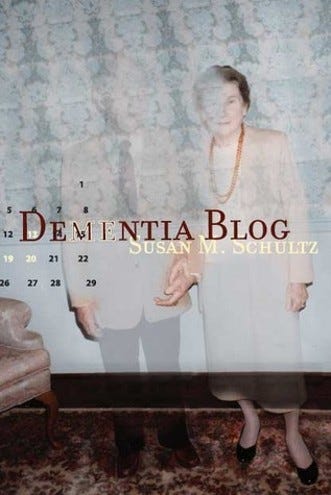
Interview with author Susan M. Schultz on her collection, Dementia Blog, Volume 1 (Singing Horse Press, 2008).
"Is there a spirit in dementia, if not a system of belief, then its flickerings, its necessary failures?” (104)

It isn’t often that one finds a literary comrade by near-accident. The interview I conducted with author and small press publisher Susan M. Schultz probing a wide array of topics and centering the subject of a cognitive brain disorder that befell her mom felt like a perfect storm, the confluence of ideas in waiting. I don’t typically care for conversations that take “synchronicities” as their harbinger (that word “synchronicity” has always seemed cringe-worthy to me, given its present-day usage by overblown self-help gurus, spiritual advisors, politicians, or what I’ll refer to as snake oil salesmen who blather on about “divine timing”). There is that maxim, however, which states that even a stopped clock is right twice a day. There was something a touch auspicious about our talk. It occurred to me mid-swing that I have spent the better part of my adult life serving in the role of caretaker for friends, former lovers, and family members for whom illness arrived in their lives as peculiar turns of events. Then, there is my second book of poetry, Discordant (Autumn House Press, 2023), which, in part, takes aim at legislative disregard for the working poor, largely black and brown people, amid the backdrop of the Forever War and a bloated US military apparatus; it is tied to the concept of parrhesia and notions about what art can do (if anything) in the face of apathy and hopelessness.
RH: In DB1, you talk about “occlusion of memory,” having listened to the treasure-trove of lies predicated by the Bush administration on the reasons for the US invasion of Iraq.
SMS: The new(est) war against Iran brings a lot of the Iraq War material into a new focus (or lack thereof). The road to war against Iraq was longer than this one, and involved attempts to persuade the American people that the war was necessary
RH: A kind of sick neologism called “buy-in”—
SMS: … even if that persuasion depended on lies. This time, no one has been persuaded of anything by anyone. It’s as if we’re suddenly in the middle of a long and awful war, having no idea how we got there. There weren’t even lies, though there is rampant abuse of the language. We have a history of that war (also illegal). But of this one we do not. It’s not willed forgetting by our government, but simply a lack of anything that will be remembered as rationale. It’s like we started inside dementia, rather than having it slowly imposed upon us.
RH: Right. At one point in the book, you mention that your mother forgave the president (George W. Bush) for his lies. Can you discuss the mediated views espoused during those years, and how memory functioned to hide truths from the American public? Beyond the sense of feeling perhaps helpless at your mom’s demise, is there a way in which remembering her before and during the ordeal is a kind of intervention on the part of you, the writer, to correct the record thereby dignifying your mom?
SMS: My mother forgave Bush (at least in one conversation she had with my husband, where she defended Bush against the term “war criminal”) because she’d forgotten so much about herself: her hatred of war, her love of language, her adamant liberal politics. And she didn’t recognize lies any more, as we discovered when the social workers taught us “therapeutic lying.”
So, what can we recognize now, in this more surrealist time? When an old-fashioned use of the word “madness” makes more sense than any logical argument, by far.
RH: Right.
SMS: After my mother died, I realized that Dementia Blog would end with her. But I also knew that the two books had only presented her as she was in her last years, when dementia was her devolving state. She had been such a fascinating and complicated person before the dementia set in. Her life had been adventurous, her stories wonderful. So began that long last catalog of her stories, in very short form, the ones I remembered as I wrote them down.
RH: It calls to mind what the daughter of the famous actor and activist Danny Glover recently stated about her dad’s “occlusions” or the first time she discovered that Glover might be suffering cognitive decline (According to news reports, Glover was first diagnosed with Alzheimer’s in 2023, a diagnosis he largely hid from the public, given his celebrity status); she noticed that her father could not remember parts of stories that he once recounted perfectly.
SMS: I hope the account of my mother’s life gives the reader a better sense of her history as a person and provides a context around her later years. When I asked her if she remembered World War II and she said she did not, I was shocked. Her life history (or stories) offer reasons for that.
Her childhood was full of trauma, and she saw things during WWII that scarred her, like the liberation of Dachau. So that’s the cultural and political end of things; her stories themselves often dressed up horrible events with a turn of her wit. But her dementia was “natural,” if one can call it that, two similar experiences of forgetting, hence the conflation of them in my books. But not the same. And these go along with the active attempts by the Bush administration to make us accept their version of “reality.”
RH: The period between your mother’s diagnosis and her actual death is surprisingly generative in DB1. This period marks a kind of refusal that you associate with language or maybe linguistic inventiveness. I am struck by the statement, “when the failure to die does not open the possibility of (re)birth” (39). It’s a kind of morass. How would you classify that kind of grief? Is grief even the right way to describe what the speaker is experiencing? What do we do when an experience does not establish or further one’s sense of what is possible?
SMS: That was a central obsession of this project. I knew I was grieving, but I was also interacting with a living being, my mother, however different she had become. I thought a lot about elegy, how we use poems to work through our grief. But that grief, traditionally, comes after the finality of death. My grief, the grief of those of us with relatives who suffer dementia, was perpetual, ongoing, didn’t come of an ending, but was an excruciating non-ending. The time was generative because the questions were so basic: can grief be for the living? What is your identity, when you lose your language, your sense of self and others? It was also generative because my line of work was poetry, where I learned a lot about identity and grief along the way. The lack of answers paradoxically became an echo chamber.
RH: Certain forms of lyrical poetry bear a striking resemblance to the often-vapid speech acts of politicians and their speech writers who pay deference to economy of language at times to paper over “the facts,” doing so in “measured” ways so as to give the public only the bare essentials.
SMS: The lyric poem often suggests an answer at the end, a “balm,” consolation. The lyric is itself final. Poetic prose is more an ongoing process, immersed in time rather than reaching outside of it. I’m not being entirely fair to the lyric poem, but I had come to resist it as a machine that drove me toward “truths” that were as impermanent as the present moment is, even as they announced themselves as final. So, I gave up poetry for prose (and only recently returned to poetry in a sequence of elegies after the murder of my dear friend, Caroline Sinavaiana-Gabbard.)
RH: I remember hearing about that! Such an awful ending to a seemingly rich life. While calling out politicians for the impunity granted them does not directly help us contend with the devastating impacts of grief or loss, it does dignify countless people whose lives such callous statemen saw as footnotes. For example, fond memories are omissions and perhaps disingenuous ways of thinking about how former U.S. Secretary of Defense, Donald Rumsfeld, the war-hawk who was accused of human rights violations, of having prior knowledge of the torture and abuse of detainees in Iraq and Afghanistan and Guantanamo Bay, Cuba, is later repackaged as a pal, a family member who will be sorely missed. In his retirement from office, he kicked any notion of scrutiny and personal accountability in the ass on his way to vacation on the Canary Islands, presumably. Pardon my sarcasm, but your book is full of sharp quips and zings. How did lyric poetry and mediated news align or misalign in DB1?
SMS: Rumsfeld is a strange and disturbing case. He’s not a lyric poet, though I gather he admired lyric poetry. He’s more Steinian or Seussian, as if his language were bearing witness to its own absurdity, even as he thought he was being clever.
RH: I re-watched snippets of filmmaker Errol Morris’ The Unknown Known. I was struck by Rumsfeld’s explanation of the concept. Oh, and that ominously rictus grin on his face as he deflected. I much prefer the work of poet and sound artist Tracie Morris (“My Great Grand Aunt Speaks to a Bush Supporter”) as antidote to Rumsfeld’s wordplay any day. He could have taken lessons from Al Jarreau or Das EFX as well!
SMS: In the case of Rumsfeld’s bizarre scenario, someone like Colin Powell would be a lyricist, or at least a documentary poet, while Rumsfeld has moved past the force of examples into abstract language. “The news” exists in a space between these poetic forms, providing information without resolution, but providing the material for causes and effects to be gleaned. At least old-style journalism did. It assumed that words referred to facts.
RH: Right. That is precisely why I detest the way the word synchronicity is deployed so often to unsee causes and effects. Often when things are divinely timed or synchronal, folks don’t have to be held accountable for anything. Speaking on the “poetry” of Rumsfeld, DB1 seems to push at its own kind of ars poetica or poetics. Take, for example, the following lines:
“It is the greatest poem, and it failed.” (24)
“Refuse closure, the poet insists. Language offers no RSVP to our insistence that it hold like a
cave or perfect sentence” (18)
“Dissolution of language, not by syllables but by what is no longer contained in or by them. What she no longer says takes more time not to say. (29)
“The poem is a closed system, no matter its length. To return to a closed system, with a view to keeping it open, leaves what we call a “publishing history.” (31)
“Minutes matter in a murder, or in a poem.”
“Rhetoric is not susceptible to democracy, only to the bottom line.” (31)
“When the poem’s voice refuses to change. When the poem’s voice is of statement only. I do this and I do that. Make things with words, but let them alter ....” (35)
“I write because I do not understand. Writing fails to make it mean. Where communication fails to make mean what cannot be made sense of, what then?” (72)
SMS: Oh, I do have a tendency toward aphorism, if not vatic pronouncement, and you’re presenting a vein of it here. I suspect almost everything I write is an ars poetica, as I’m always thinking about writing or photography as I’m doing it. It’s my attempt to make of the ordinary, the banal, the disturbing, something meaningful. I simply cannot do without meaning. I think Ashbery said that somewhere, too, though his work was usually more lyrical. It’s that ghosting you spoke of earlier, between me and my mother, or between the word and what it represents.
Something gets lost, but entropy often steps in with the richness of a multiple-choice test in which every answer it true. I used to adore silences, but I’m more skeptical now. Words can’t get us everywhere, but they are pleasurable and meaningful, a bit like breathing. I’m enough of a mystic to know that they don’t get us to the truth, but they may get us to a gap in the wall between us and it.
RH: What can be made of the references to inside and out, public versus private, domestic versus international, which lends itself to a conversation about provincialism, the concept of interiority and confession in poetry. You write:
“It is the form of war that worries us, but its content is blood on the street.” (64)
I don’t read this as a moral imperative, but there is something here. June Jordan could not turn away from the question of a free Palestine, the ways we might all be implicated by looking away in times of war. What happens when the content is the killing machine that is US imperialism? The poet bears witness as is often said. I feel like you bore witness to the blurring of divisions as it pertains to the “private” affairs of your mother, the public affairs of a nation whose oligarchs play political football with its citizenry. We learned that the US along with Israel targeted and bombed a school for girls in Iran, reportedly killing 165 schoolgirls. Did blurring the lines between public and private help you arrive at a new set of questions?
SMS: I think my mother led me there, with her deep interest in war and politics, an interest that always intersected with her personal life. As a child, I realized that she was a historical character (not in the sense of famous, rather of someone living inside history). My most recently published book, War Diary (Spuyten Duyvil), considers the act of witness that’s mediated by screens. We witness the war in Ukraine, without being able to touch it. How do we do that? I admire poets who use form well, but too often it feels like a container that points to itself rather than to what’s inside of it, or what spills out. Prose is public. Prose poetry is public and private. That’s to simplify genre (again!) but I do believe that prose contains all genres, and so is well suited to this private/public mix/mess that fascinates me. It’s also a mix of emotions with responsibilities, self with community (one hopes). The sadness is that witness often feels like another form of hopelessness. But it’s important to keep records, not forget . . .